Can Your HOA Ban Political Yard Signs? What State Law Actually Says
How state statutes in California, Texas, and elsewhere override HOA sign bans for political and noncommercial signs, what reasonable restrictions HOAs can still enforce, and how to check your own state.
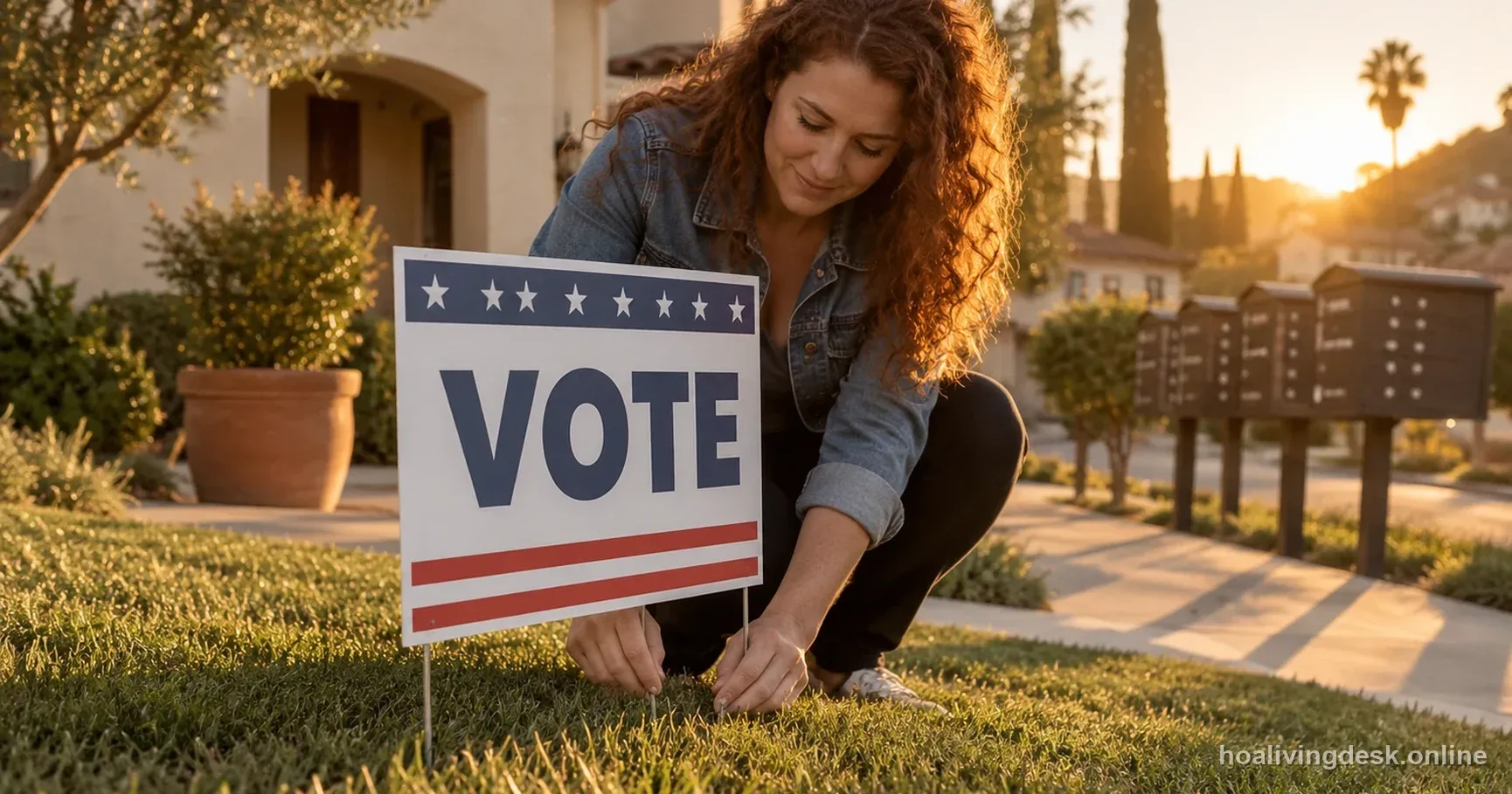
Many HOA declarations still contain a blanket ban on "signs of any kind" written decades before anyone thought to test it against a state's free-expression protections. In a growing number of states, that blanket ban is simply unenforceable against political and other noncommercial signs, regardless of what the association's own governing documents say.
The general rule: state law overrides the declaration
When a state statute conflicts with an HOA's declaration or rules on this specific point, the statute controls, and the declaration's conflicting provision is void even if it predates the statute and even if the membership never amended it. Boards sometimes act as though a declaration provision is untouchable because owners agreed to it at purchase; on political and noncommercial signage, many states have simply decided that private contract does not get to override a resident's ability to express a political or civic view from their own property.
California: Civil Code Section 4710
California Civil Code §4710 prohibits HOAs from banning noncommercial signs, posters, flags, or banners displayed from a member's own separate interest — yard, window, door, balcony, or exterior wall — except where necessary for public health or safety, or where the sign itself would violate another law. The statute also limits the sign's materials: it cannot be built from lights, roofing, siding, paving materials, flora, or balloons, which keeps the protection focused on ordinary printed or painted signs rather than permanent structural additions.
Texas: election-season protection with real limits
Texas has protected political sign display in HOA communities since House Bill 873 in 2005, now codified largely in the Texas Election Code. The protection is time-boxed: it applies from 90 days before an election through a defined period after. Within that window, associations can still impose content-neutral, reasonable restrictions: requiring signs to be ground-mounted rather than attached to structures, limiting owners to one sign per candidate or ballot measure, capping sign size (commonly four feet by six feet), and banning illuminated signs, moving parts, balloons, streamers, or signs attached to trees, utility poles, or vehicles.
Other states worth checking specifically
Virginia, Colorado, and a number of other states have their own sign-protection provisions layered into their common-interest-community acts, often narrower than California's or differently timed than Texas's election-window model — some protect signs only during a defined pre-election period, others protect a broader category of noncommercial expression year-round but cap the number or size more tightly. Because state legislatures have kept amending these provisions through the 2020s in response to HOA disputes, a statute your association's declaration was written against may already be out of date; check your current state code section directly rather than relying on the declaration's own description of what's allowed.
Declaration vs. bylaws vs. rules: which one actually governs signage
Sign restrictions can appear in the declaration (CC&Rs), in separately adopted rules and regulations, or in both with conflicting language. Where a state sign-protection statute applies, it overrides all of them equally — a rule adopted by the board last year is no more enforceable against a protected sign than a CC&R provision from 1985. But where a specific restriction (like Texas's ground-mount requirement) is left to the association's discretion, the source of that restriction can matter for how it was adopted and how it can be challenged — a rule adopted without proper notice-and-comment procedure required by the bylaws may be separately vulnerable on procedural grounds even if its content would otherwise be permissible.
What HOAs can still enforce almost everywhere
- Reasonable size limits, even where signs themselves cannot be banned outright.
- A cap on the number of signs displayed at one time.
- A requirement that signs be freestanding or ground-mounted rather than attached to the building or common elements.
- A ban on illumination, motion, or attachment methods that damage siding, trees, or shared structures.
- Time windows tied to an actual election cycle, where the statute itself defines one (as in Texas).
Check your own state before assuming either extreme
Sign-protection statutes vary significantly in scope and are not universal — some states protect only political signs during election season, some protect any noncommercial sign year-round, and a smaller number have no statute at all, leaving the HOA's declaration as the controlling document. Do not assume your state mirrors California or Texas; search your own state's statutes (often under the state's condominium act, planned community act, or election code) for language specifically addressing HOA sign restrictions before either posting a sign you assume is protected or enforcing a ban you assume is enforceable.
Why this differs from commercial and real-estate signs
Most of these statutes specifically protect noncommercial expression — political, religious, or civic messages — and do not extend the same protection to commercial advertising or, in many states, real-estate "for sale" signs, which are often governed by a separate statute with its own rules. Don't assume a political-sign protection automatically covers a business sign or a for-sale sign; check the specific statute's scope.
A practical step before posting a contested sign
Pull your state's specific statute text (not a secondhand summary) and compare it line by line against your sign: does it fall within the protected size, is it noncommercial, is it within any election-window timing the statute defines, and is it ground-mounted rather than attached to a shared structure. Owners who do this homework before posting, and who keep a printed copy of the statute on hand, resolve disputes with management companies far faster than owners who argue from a general sense that "political signs are protected."
One more practical wrinkle: several of these statutes distinguish between a sign posted on your own lot and a sign posted in a common area or on association-owned property. The protection almost always covers only your own separate interest — your yard, your window, your balcony — not a shared entrance, a community bulletin board, or a common-area fence, where the association retains much broader control regardless of the sign's political content.
Questions homeowners ask
Does my HOA have to allow a political sign of any size?
No. Even in states with strong sign-protection statutes, HOAs typically retain the right to enforce reasonable size and placement limits. A sign that is oversized, illuminated, or attached to common structures can usually still be restricted even where a flat ban would be illegal.
What if my state has no sign-protection statute at all?
Then the HOA's declaration and rules generally control, and a blanket sign ban may be fully enforceable. This is genuinely state-dependent — check your specific state's statutes rather than assuming protection exists everywhere.
Can an HOA ban a sign supporting a specific candidate but allow general political signs?
Content-based restrictions like this are on much shakier ground under most sign-protection statutes, which are typically written to protect noncommercial speech regardless of its specific viewpoint. A rule that singles out particular candidates or messages is more likely to be challenged successfully than a content-neutral size or placement rule.