HOA Pool and Clubhouse Rules: How Guest Passes, Waivers, and Reservations Typically Work
Common practices for HOA amenity access — guest limits, fees, liability waivers, and reservation systems — and the one waiver question that stays genuinely unsettled.
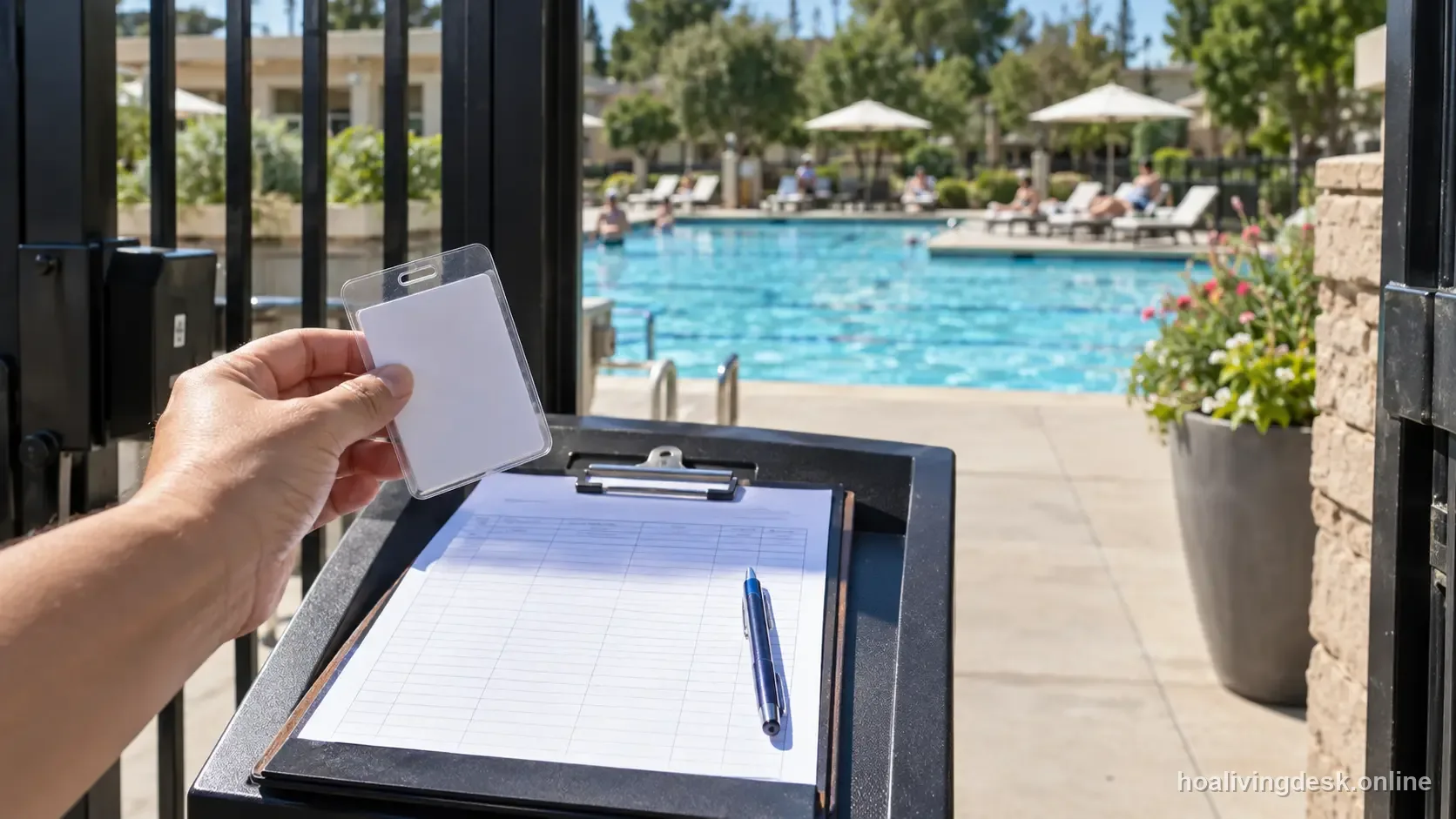
Amenity rules — who can use the pool or clubhouse, how many guests you can bring, and what paperwork you need to sign first — are some of the most immediately practical things to understand after moving into an HOA, and they vary more by individual community than most other HOA topics, since there's generally no statute dictating pool policy the way there is for, say, lien priority. What follows is common practice across many associations, worth confirming against your own community's specific rules.
Guest access: typical structures
Many communities require the resident to accompany their guests at the pool or clubhouse rather than allowing guests unsupervised access, and some use a day-use guest pass system instead, with a typical guest fee in the range of $5 to $25 per visit depending on the community. Caps on the number of guests per household per day are also common — one documented example allows up to 10 guests per day through pre-issued seasonal passes, though the specific number varies widely by association.
Liability waivers
Most associations require some form of liability waiver before granting pool or amenity access, acknowledging the inherent risk of the activity and releasing the association from liability for guest injuries. Many communities have moved to digital, e-signature waiver systems, which create a timestamped record of compliance that's easier for the association to manage than paper forms, and easier for a resident to complete in advance rather than at the gate.
Reservation systems and other common bundled rules
Clubhouses and, in some communities, pool areas are often managed through a reservation system for private use (a birthday party or gathering, for instance), sometimes requiring a refundable deposit against damage or cleaning. Pool rules frequently bundle in age restrictions (a minimum age to swim unsupervised, for example), posted hours, and alcohol policies, all as part of the same rules package residents are expected to review when they move in.
| Rule type | What to look for |
|---|---|
| Guest limit | Per-visit or per-day cap on number of guests |
| Guest fee | Flat per-visit fee, commonly cited in the $5–$25 range |
| Liability waiver | Digital or paper, required before first access |
| Reservation system | For private clubhouse use, sometimes requiring a deposit |
| Age restrictions | Minimum age for unsupervised pool use, if any |
| Hours and alcohol policy | Posted operating hours and any alcohol restrictions |
What to do in your first weeks
- Request the specific amenity rules document from the management company or board — this is often separate from the main CC&Rs and bylaws.
- Complete any required waiver as early as possible rather than waiting until you want to use the amenity, since some systems take a few days to process.
- Ask specifically about the guest policy — per-visit fee, daily cap, and whether you need to accompany guests — since this is one of the more commonly misunderstood rules for new owners.
- If you plan to host a gathering at the clubhouse, ask about the reservation process and any deposit requirement well before your planned date, since availability can be limited.
- Keep a copy of your signed waiver and any amenity access card or fob information in an easy-to-find place, since replacement processes vary by community and can take time.
This is a lower-regulation topic — house rules genuinely vary
Unlike lien priority or interest rate caps, amenity access rules are set almost entirely by each individual association rather than by statute, so there's limited value in treating any specific number above (guest fee amount, guest cap, minimum age) as a rule that applies to your community specifically. Use this as a framework for what questions to ask, and get the actual answers from your own association's rules package.
What to do if amenity rules seem to be enforced inconsistently
Inconsistent enforcement of amenity rules is a common source of resident frustration — one family seems to bring unlimited guests without being questioned while another is stopped at the gate over a technical violation. If you notice a pattern like this, it's worth raising directly with the board or management company rather than assuming the rule itself is the problem, since inconsistent enforcement can sometimes expose the association to fair-housing or selective-enforcement concerns depending on the specifics involved.
Keeping your own simple record of amenity use — dates, guest counts, any interactions with staff or other residents — can be useful if you ever need to demonstrate a pattern of inconsistent treatment, though most day-to-day friction over guest counts or minor rule violations resolves through a direct conversation with the board long before it becomes a formal dispute. Approach the conversation by asking how the rule is supposed to work in practice, rather than immediately alleging unfairness, since board members and volunteer committees enforcing amenity rules are often working from incomplete information themselves.
If your community uses a digital guest-pass or reservation system, keep your own login credentials current and know how to reset access if it lapses, since a technical access problem at the gate is a common and avoidable source of frustration that has nothing to do with the underlying rules themselves. A quick check of your account status before a planned gathering can save an awkward moment for you and your guests.
Questions homeowners ask
Can my HOA charge a fee for pool guests?
Yes, this is common practice — guest fees in many communities fall in a roughly $5 to $25 per-visit range, though the specific amount and structure (per visit vs. day pass) is set individually by each association.
Do I have to sign a liability waiver to use the pool?
Most associations require some form of waiver before granting access. Whether the HOA can actually deny access to someone who refuses to sign is a genuinely unsettled, state- and situation-dependent legal question.
Can I reserve the clubhouse for a private event?
Many communities allow this through a reservation system, sometimes requiring a refundable deposit against damage or cleaning — check your association's specific process and any advance-notice requirement.
Are amenity rules the same in every HOA?
No. Unlike topics governed by state statute (like lien interest caps), amenity access rules are set individually by each association, so guest limits, fees, and waiver requirements vary significantly by community.