Florida's SIRS and Milestone Inspections: What Condo Owners Actually Owe
Florida's Structural Integrity Reserve Study and milestone inspection rules explained for condo owners and boards: deadlines, what gets inspected, and why reserves can no longer be waived.
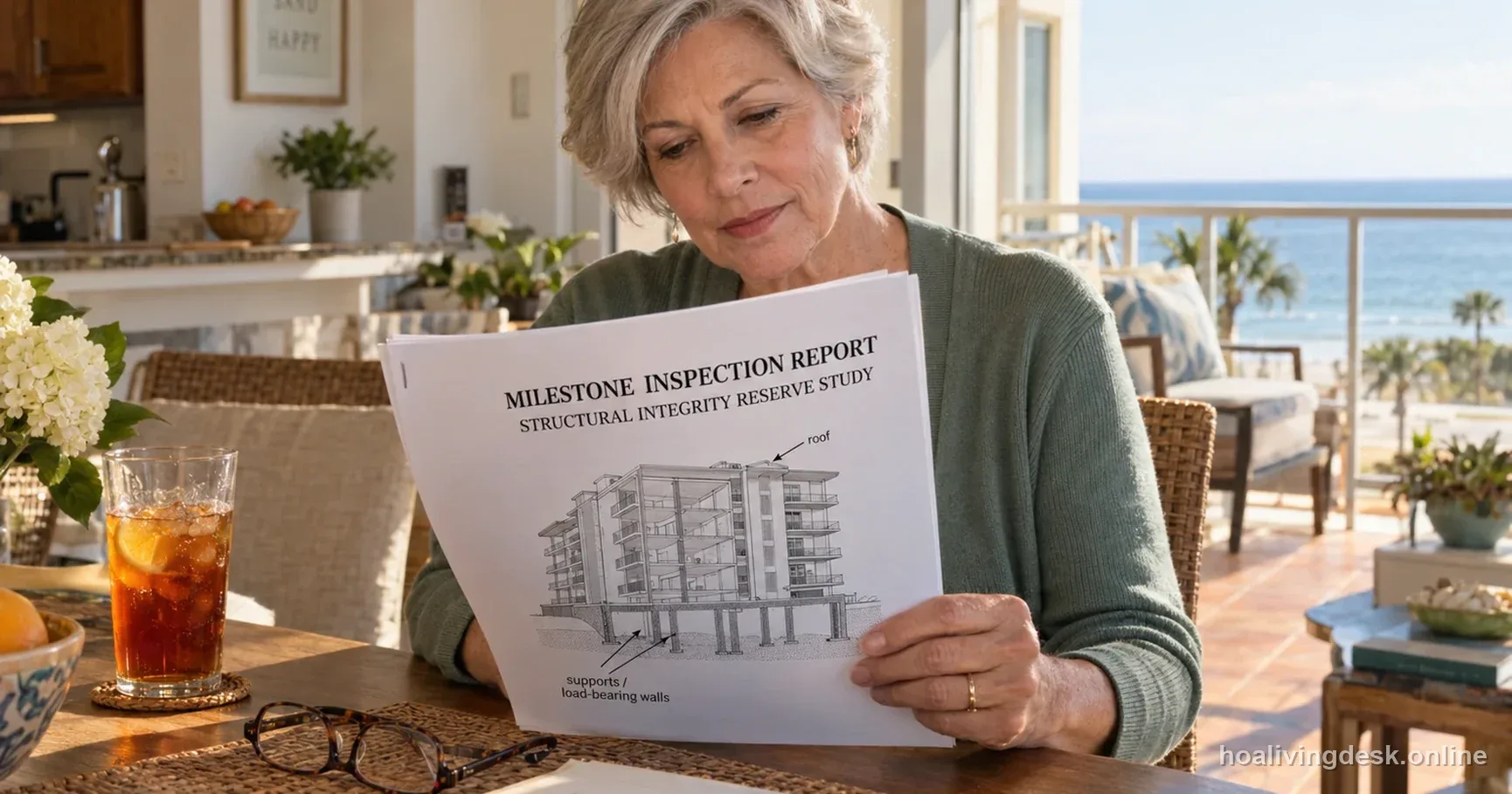
If you own in a Florida condominium three stories or taller, two separate but related obligations now govern your building: a milestone structural inspection and a Structural Integrity Reserve Study (SIRS). They came out of the same reform push after the 2021 Surfside collapse, but they answer different questions, run on different clocks, and a board that treats them as one item on a checklist tends to miss deadlines on the other.
Two rules, two different questions
The milestone inspection, created by Senate Bill 4-D (2022) and codified at Florida Statutes 553.899, asks whether the building's structure is currently safe. A licensed architect or engineer performs a Phase 1 visual inspection at 30 years of age (25 years if the building sits within three miles of the coast), and again every 10 years after that. If Phase 1 finds evidence of "substantial structural deterioration," a more invasive Phase 2 inspection follows.
The Structural Integrity Reserve Study, required under Florida Statutes 718.112(2)(g) and refined by Senate Bill 154 (2023), asks a financial question instead: does the association have, or have a real plan to have, enough money set aside for the building's major structural components before they fail? A SIRS engineer or licensed professional evaluates load-bearing walls, primary structural members, floors, foundation, roof, fireproofing, plumbing, electrical, waterproofing, and windows/exterior doors, then projects the remaining useful life and replacement cost of each.
The deadlines that actually matter right now
| Requirement | Who it applies to | Deadline |
|---|---|---|
| First SIRS | Owner-controlled associations that existed on or before July 1, 2022, buildings 3+ stories | December 31, 2025 |
| Milestone inspection (non-coastal) | Buildings 3+ stories, 30 years old | Within the year the building turns 30, then every 10 years |
| Milestone inspection (within 3 miles of coast) | Buildings 3+ stories | Within the year the building turns 25, then every 10 years |
| Combined SIRS + milestone | Buildings whose milestone inspection is due on or before Dec 31, 2026 | May be coordinated together, but SIRS still cannot go past Dec 31, 2026 |
A building that already completed its milestone inspection years before SB 4-D existed does not get to skip the SIRS. The two requirements are independent: an association can be current on its milestone inspection and still be out of compliance on its reserve study, or vice versa.
Reserves can no longer be waived away for these components
This is the change that has hit owners' wallets hardest. For any association budget adopted on or after January 1, 2025, the board and the membership can no longer vote to waive or underfund reserves for the specific components a SIRS identifies as structural. Older Florida law let a majority of owners vote every year to waive reserve funding entirely, which is exactly how many associations arrived at 2022 with reserve accounts far short of what a real structural repair would cost. That escape hatch is now closed for SIRS-covered items, even if the membership would vote unanimously to keep dues low.
Why this shows up as a special assessment, not just higher dues
Associations that spent years underfunding reserves under the old waiver rules do not get retroactive relief. When a SIRS reveals a multi-million-dollar gap between what is saved and what a component will cost, boards generally have two levers: raise regular assessments sharply, or levy a special assessment to close the gap faster. In practice most underfunded associations have used both. Some unit owners have faced five- and six-figure special assessments tied directly to milestone and SIRS findings, and that exposure is now a material part of what you are buying when you buy a Florida condo unit, not a hypothetical risk.
The lending and insurance angle
Fannie Mae, Freddie Mac, and condo insurers have all tightened how they treat buildings with unresolved milestone or SIRS findings, deferred maintenance, or reserve shortfalls. A building flagged as "unsafe" after Phase 1, or one that cannot show adequate reserve funding, can become difficult for buyers to finance and difficult for owners to insure at a reasonable rate — which depresses resale value independent of the physical condition of any one unit.
What to actually check before you buy or as a current owner
- Ask the association directly for the building's most recent milestone inspection report and its current SIRS — not a summary, the actual documents.
- Check the building's age and coastal distance yourself; do not rely on the seller's or listing agent's assumption about when the next inspection is due.
- Compare the SIRS funding schedule against the current reserve balance and the current budget's actual reserve contribution line — a gap here is the single best predictor of a coming special assessment.
- Ask whether any Phase 2 inspection has ever been triggered, and if so, what was found and what was repaired.
- For a unit you already own, attend the board meeting where the SIRS is presented; the funding plan the board proposes there is what will show up on your next assessment.
Other states are watching Florida's model
Florida moved first and hardest after Surfside, but it is not alone. California requires periodic inspection of exterior elevated elements such as balconies and walkways under SB 326, and several other states have introduced or passed their own structural inspection or reserve-disclosure requirements for aging condo stock. If you own outside Florida, do not assume your building is exempt from every version of this issue — check whether your state has adopted its own inspection or reserve-funding statute, since the underlying problem (aging buildings, historically underfunded reserves) is not unique to Florida.
Questions homeowners ask
Does SIRS apply to HOAs with single-family homes, or only condos?
SIRS and the milestone inspection statute apply specifically to condominium associations with buildings three or more habitable stories. A single-family or townhome HOA without a qualifying condo building is not subject to these two statutes, though it may have its own state's reserve-study requirements.
Can a small condo building just skip the SIRS if it can't afford one?
No. The statute does not have a financial-hardship exemption from performing the study itself. What boards can sometimes negotiate is the funding timeline for the resulting reserve schedule, and coordinating the SIRS with an already-scheduled milestone inspection to control the total cost.
If a building passed its milestone inspection, does that mean the SIRS will be fine too?
Not necessarily. The milestone inspection is a snapshot of current structural safety. The SIRS is a financial forecast of future replacement costs for components that may currently be safe but are near the end of their useful life. A building can pass its milestone inspection and still show a large reserve funding gap in its SIRS.
Who actually performs a SIRS?
Florida law requires the study be performed or supervised by a licensed engineer or architect, though a reserve specialist may assist with the financial projections. It is not something a board or management company can complete internally.