HOA Parking Rules, Guest Permits, and Towing
How to analyze an HOA parking or towing problem by identifying street ownership, space rights, the exact vehicle rule, notice, towing authority, and retrieval records.
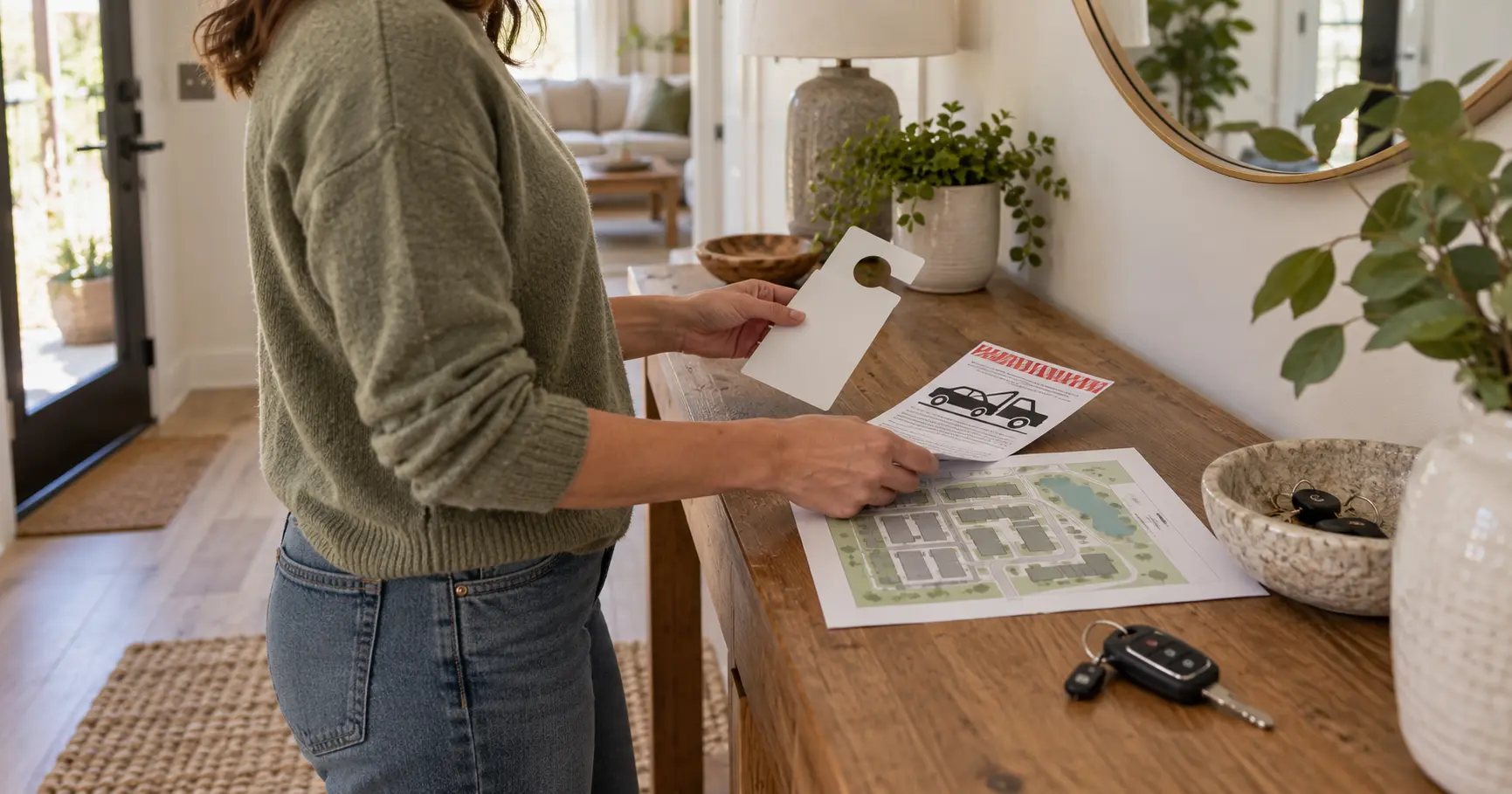
Parking disputes are impossible to analyze until you know who controls the pavement. A curb inside an HOA can be a public street, private association road, common parking area, deeded space, assigned limited common element, or a private driveway. The same vehicle can be regulated differently depending on where it sits.
Identify the legal parking surface first
Check the plat, declaration, parking map, deed or unit schedule, and local street records. A rule that authorizes towing from association common property does not automatically give the HOA authority to tow from a city street. Conversely, a space painted with your unit number may still be common property subject to association rules rather than deeded real estate.
Then identify the exact vehicle rule
- Commercial vehicle definition: lettering, weight, equipment, registration class, or actual use.
- Guest permit rules: duration, registration, renewal, and number of permits.
- RV, trailer, boat, or oversized vehicle restrictions.
- No-parking zones tied to fire access, gates, hydrants, or service areas.
- Time limits for street, lot, or visitor-space parking.
- Rules for inoperable, unregistered, or leaking vehicles.
Towing is a separate authority question
Even if a vehicle violates HOA rules, state towing law may require signage, notice, authorization, tow-company procedures, or limits on when a private-property tow can occur. Those rules are highly jurisdiction-specific. If your vehicle was towed, get the tow receipt, location, authorization information available to you, photographs, and the association rule before arguing about the underlying violation.
Build a five-point tow timeline
- Where and when the vehicle was parked.
- What sign, permit, or rule applied at that exact location.
- Whether a warning or violation notice was given and when.
- Who authorized the tow and under what association policy.
- When and where the vehicle was retrieved, including all charges paid.
| Dispute | Evidence to collect |
|---|---|
| “This is a public street.” | Municipal map, plat, maintenance records |
| “My permit was valid.” | Permit screenshot, guest registration confirmation |
| “The sign was missing.” | Dated photos of entrance and parking area |
| “The vehicle is not commercial under the rule.” | Registration, photos, rule definition |
| “I was in my assigned space.” | Parking schedule, deed/exclusive-use map, association assignment |
Do not confuse assignment with immunity from rules
An assigned space can still be subject to fire-code, storage, vehicle-type, repair, or permit rules if the association has authority. The assignment gives you a parking right; it does not necessarily convert the space into unrestricted private property. Read both the assignment source and the general parking policy.
Guest permits need a household procedure
If guest parking is tightly controlled, save the registration link, permit limits, and after-hours contact in your phone. Tell frequent visitors which spaces are legal and whether plates must be registered before arrival. Many avoidable tows happen because an owner knows the rule but a guest assumes a blank space is available.
When the dispute is with the city, not the HOA
If the street is public, parking enforcement may be controlled by municipal code and police or parking authorities. The HOA may still send a covenant notice about a vehicle if the declaration lawfully regulates owner conduct, but physical towing authority can be a different issue. Separate private covenant enforcement from public parking enforcement.
The shortest path through a parking dispute is location, ownership, rule text, notice, and tow authority. Without those five facts, arguments tend to become assumptions about who 'owns the neighborhood.'
Photograph the signs before you need them
Take clear photos of every towing or permit sign at the entrance and in the relevant parking area, including the full wording, phone number, placement, and date. Save the current parking rule and your permit record. If a tow happens later, you have evidence of what notice existed before the dispute rather than photos taken after signs may have changed.
For a specific tow, write the timeline in minutes: when the vehicle arrived, where it was parked, permit displayed or app session started, warning received, tow observed or discovered, number called, release time, and charges paid. Obtain the towing receipt and any association authorization or violation record you are entitled to request. Then analyze three separate questions: did the HOA have authority over the space, did the vehicle violate the applicable rule, and did the towing process comply with state/local law? A yes on one does not answer the others.
Build a household guest-parking protocol
If guests are the recurring problem, write a simple household instruction with the correct lot, permit method, hours, prohibited spaces, towing number, and screenshot steps for any parking app. Send it before the guest arrives. Most parking disputes are cheaper to prevent than to win, and a clear guest protocol is more useful than knowing the appeal process after the vehicle is already at the tow yard.
If the vehicle is on a public street, check the municipal parking and towing rules before assuming the HOA controls the curb. Some declarations regulate owner conduct related to street parking even when the street is public, while actual towing authority may belong to government or depend on different law. Separate covenant enforcement from physical towing authority.
When you recover a towed vehicle, pay attention to damage before leaving the lot and photograph the vehicle. A disagreement over HOA authority and a separate claim for towing damage are different issues with different evidence, and combining them can make both harder to resolve.
Questions homeowners ask
Can an HOA tow from a public street?
Not merely because the street is inside the community. Public-street towing authority comes from public law. The HOA may have other covenant remedies, but determine street ownership and local law first.
Does an assigned parking space belong to me?
Not necessarily. It may be deeded, an exclusive-use common element, or a revocable assignment. Check the declaration, deed, and parking schedule.
Can I challenge towing fees after paying them?
Possibly. Retrieval payment and a later challenge are separate questions in many jurisdictions. Keep receipts and act within any local complaint or legal deadline.
Can an HOA ban work trucks?
It depends on the governing documents, rule language, property location, and state law. Definitions matter; a personal pickup is not automatically a “commercial vehicle” simply because it is used for work.