Installing an EV Charger When You're in an HOA
A practical EV-charger path for HOA owners: parking rights, electrical capacity, metering, architecture, insurance, shared property, and state right-to-charge laws.
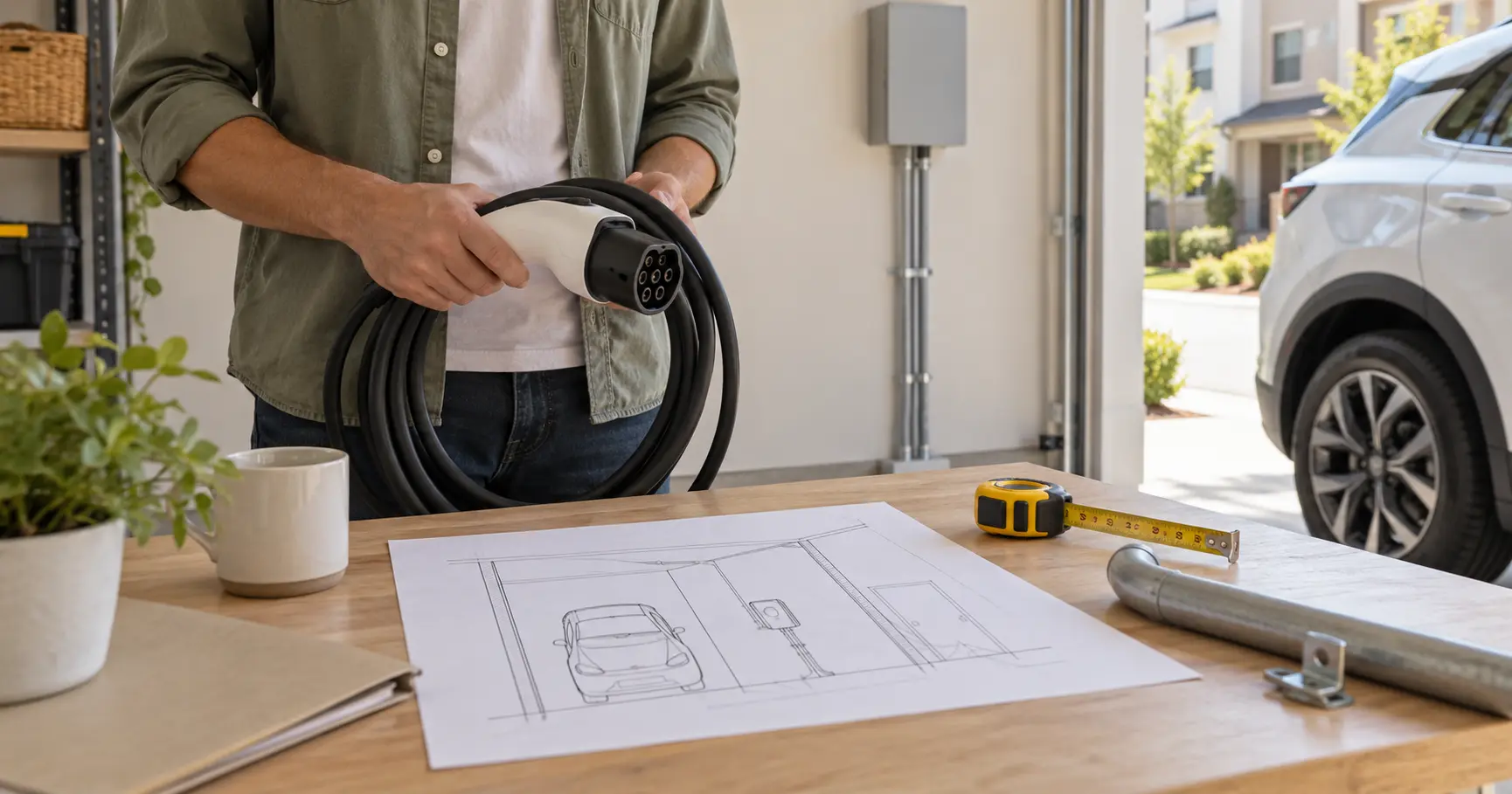
An EV charger request has three layers that ordinary exterior projects do not: parking rights, electrical infrastructure, and who pays for electricity over time. Before choosing hardware, identify whether the parking space is inside your unit, deeded, exclusive-use common area, assigned common area, or general common parking. That classification can determine what approval and agreement you need.
Map ownership before wiring
In a detached home with a private garage, the electrical route may stay entirely within property you control, making the HOA review mostly architectural. In a condominium, the route can cross a common electrical room, wall, ceiling, garage lane, or meter bank. Draw the complete path from panel to charger and label every common-area penetration. A technically simple charger can become a property-rights project when the cable crosses shared space.
California gives a detailed right-to-charge example
California Civil Code section 4745 makes HOA provisions that effectively prohibit or unreasonably restrict covered EV charging stations void and unenforceable, while allowing reasonable restrictions. The current statute also requires written handling of applications and contains specific rules for chargers in common or exclusive-use common areas, including contractor, cost, insurance, damage, maintenance, and electricity responsibilities. That is a California framework, not a national one.
Your application should solve metering, not just installation
- Who pays for the charger, trenching, conduit, panel work, permits, and restoration.
- How electricity is measured: unit meter, dedicated submeter, network billing, or another documented method.
- Who pays ongoing network or software fees, if any.
- Who maintains and eventually removes the equipment.
- Who restores common surfaces after removal or building work.
- How future owners inherit any responsibilities attached to the installation.
Get an electrical load answer early
A charger can be code-compliant yet impossible to add without service upgrades. Ask a licensed electrician to evaluate panel capacity, feeder capacity where relevant, and whether load-management equipment can avoid a larger upgrade. In a shared garage, the association may need an engineer or electrician to evaluate the building system rather than relying on one unit's panel calculation.
| Scenario | Likely practical issue | Document to prepare |
|---|---|---|
| Private garage, private panel | Appearance and permit | ARC form + one-line diagram + equipment cut sheet |
| Assigned condo space near common panel | Common-area route and metering | Electrical plan + license/maintenance agreement |
| Shared parking with no dedicated space | Allocation and access | Parking-right evidence + association-wide charging policy discussion |
| Multiple owners want chargers | Capacity planning | Load study + scalable metering/network proposal |
Do not accept “insurance” as a vague condition
If the association requires liability coverage, ask for the exact amount, certificate wording, additional-insured requirement if any, and statutory or document basis. California's section 4745 is again instructive because it specifies insurance-related obligations for covered installations. In other states, the declaration, rules, insurer, or agreement may set different requirements.
Use the statute to narrow unreasonable conditions
If your state has a right-to-charge law, compare each HOA condition with the law's definition of a permissible restriction. An alternative location that doubles trenching cost, a charger type that reduces needed performance, or an indefinite delay may need closer review. Have the electrician quantify cost and performance differences rather than arguing from convenience.
Plan for building work that temporarily displaces the charger
A garage membrane repair, electrical upgrade, painting project, or parking reconfiguration may require temporary charger removal. Your written agreement should say who coordinates that work and who pays to remove and reinstall owner equipment. Without that clause, a routine common-area project can become a new dispute years later.
A good EV charger proposal answers five things before the board asks: where the space comes from, where the wire runs, whether the electrical system can support it, how electricity is billed, and who owns the long-term responsibilities. That makes approval a technical decision rather than a culture-war argument about electric cars.
Design for the second charger, not only the first
In a shared garage, the first owner can consume a convenient conduit path or panel capacity that later owners also need. Even if you are applying for one station, ask whether the association has a load-management or charging policy, spare electrical capacity, preferred raceway, metering standard, and expansion plan. A slightly more coordinated installation can prevent the board from facing a patchwork of incompatible networks and one-off penetrations.
Your proposal can help by distinguishing private costs from common infrastructure. The owner may pay for the charger and branch circuit while a future association project creates shared capacity, or the association may require a scalable network from the start. Put who owns each component into the drawing and agreement. When the charger is removed or the unit is sold, that ownership map tells everyone what stays, who maintains it, and what restoration is required.
When bids differ dramatically, compare scope rather than charger price. One electrician may include permitting, load calculations, core drilling, firestopping, network setup, restoration, and meter work while another quotes only the device and branch circuit. Give the HOA a normalized scope so reviewers do not reject a safer plan because a cheaper bid silently excludes common-property work.
If the route crosses fire-rated walls, parking decks, waterproofing, or other protected assemblies, require the contractor to show how penetrations will be restored. Those details matter more to the association than the charger brand and can prevent a technically working installation from creating a building-envelope or life-safety problem.
Questions homeowners ask
Can an HOA ban an EV charger?
It depends on state law and the property setup. Some states, including California, restrict HOA prohibitions or unreasonable restrictions on qualifying chargers. Other states may not provide the same protections.
Who pays for electricity used by a private HOA charger?
Usually the installation should include a method that assigns electricity cost to the benefiting owner, but the exact arrangement depends on the building and governing framework. Put the method in writing.
Can the HOA make me use a licensed contractor?
Often yes, especially when work touches common electrical or structural systems. Some state statutes expressly require a licensed contractor for covered installations.
What if my assigned parking space is far from my electric meter?
Ask an electrician to compare routing, submetering, load management, and shared charging options. In a condo, you may also need association approval for a common-area route or license agreement.